
Generate a secure, memorable passphrase
Table of Contents
What Is a Passphrase?
A passphrase is a sequence of random, unrelated words used as a password. Instead of a short, complicated string like P@ssw0rd123!, a passphrase looks more like sunrise velvet crater unfold. The words are chosen at random rather than forming a meaningful sentence, which is what makes them hard to guess.
The security of a passphrase comes from its length. Each additional word multiplies the number of possible combinations an attacker would need to try, making brute-force guessing far less practical. A four-word passphrase drawn from a large wordlist has more entropy than most complex passwords people create on their own.
Passphrase vs Password: Which Is More Secure?
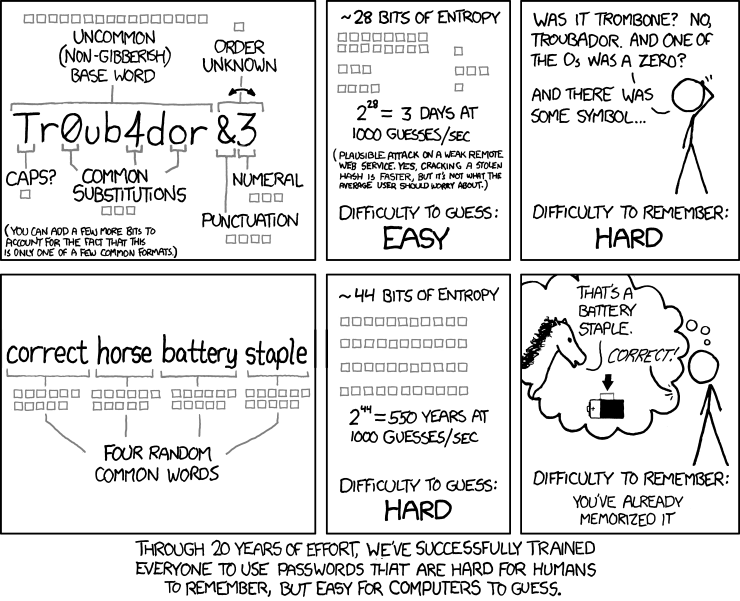
For years, the standard advice was to use short passwords with lots of special characters. Something like Tr0ub4dor&3. The problem is that while these passwords are hard for humans to remember, they're not as hard for computers to crack as you'd expect. Modern algorithms can work through billions of combinations per second, and short passwords, even complex ones, fall within reach.
This is the argument made by the well-known XKCD comic #936: a password like Tr0ub4dor&3 has roughly 28 bits of entropy, while a four-word passphrase like correct horse battery staple has around 44 bits. The passphrase wins, and it's far easier to remember.
The key differences:
- Length: passphrases are typically 20–30 characters, traditional passwords often 8–12
- Memorability: random words are easier to recall than random symbols
- Resistance to brute force: longer inputs take exponentially longer to crack
- Resistance to dictionary attacks: random word combinations aren't found in any dictionary
The main caveat: the words must be chosen randomly, not by you. People are predictable when choosing words, which reduces entropy. That's exactly what a passphrase generator is for.
Passphrase Examples
Here are examples of strong passphrases generated using random word selection:
sunrise velvet crater unfoldisland victory attic designlaptop secret rocket statueTimber-Frost-Candle-River-42(with capitalization, dashes, and a number)
Notice that the words don't relate to each other. That's intentional. A phrase like sunny beach holiday umbrella might seem random but follows a logical theme, which makes it slightly more guessable. True randomness is what the generator provides.
For most accounts, four words is a solid baseline. For high-value accounts like your email or password manager master password, five or six words gives you a significant security margin.
How to Use This Passphrase Generator
The generator at the top of this page is based on the Diceware method, a well-established approach to passphrase generation developed by Arnold Reinhold. Diceware uses large, curated wordlists to ensure true randomness, using the same technique recommended by security researchers and organisations like the Electronic Frontier Foundation.
To generate a passphrase:
- Choose a language: 11 languages are supported, including English, German, French, Spanish, and more
- Set the word count: 4 words is the default; increase to 5 or 6 for extra-sensitive accounts
- Pick a separator: spaces, dashes, underscores, dots, or plus signs
- Optional: capitalize words or add a number, useful if a site requires mixed case or digits
- Click Generate and copy your passphrase
If you'd rather have the generator in your browser at all times, we've built extensions for both Chrome and Firefox:
Is It Safe to Generate a Passphrase Online?
A fair concern. The short answer is: it depends on how the generator works. Some online tools generate passphrases server-side, which means the result technically passes through someone else's system before reaching you.
This generator works entirely in your browser. The wordlists are fetched once and all generation happens locally using JavaScript. Nothing is sent to a server, logged, or stored. You can verify this yourself by turning off your internet connection after the page loads and generating another passphrase; it will still work.
If you'd prefer not to rely on any tool at all, you can create your own passphrase manually: pick a book, open it to a random page, and select four unrelated words from different parts of the page. It's less convenient but equally valid.
How to Use Your Passphrase Securely
Generating a strong passphrase is only part of the equation. Here's how to make the most of it.
Use a password manager
You shouldn't need to memorise every passphrase you create. A password manager stores them securely and fills them in automatically, so you only need to remember one strong master passphrase. Solid options include:
- 1Password (Windows, Mac, iOS, Android)
- LastPass (iOS, Android, and browser extensions for Windows, Mac, Linux)
- KeePass (open-source, available for Linux, Windows, Mac, and Android)
Use a unique passphrase for every account
Reusing passphrases across accounts is one of the most common security mistakes. If one site gets breached and your passphrase leaks, every account that uses it is at risk. Generate a fresh passphrase for each service and let your password manager handle the rest.
Make your master passphrase count
The passphrase you use to lock your password manager is the one you actually need to memorise. Use five or six words, don't write it down anywhere digital, and treat it like the key to everything, because it is.
Frequently Asked Questions
What is a passphrase?
A passphrase is a sequence of random, unrelated words used in place of a traditional password. Its security comes from length rather than complexity. Four or more random words create far more possible combinations than a short string of mixed characters.
Is a passphrase more secure than a password?
Generally yes, as long as the words are chosen randomly. A four-word passphrase from a large wordlist has significantly more entropy than most human-created passwords, and is far more resistant to brute-force attacks.
How many words should my passphrase have?
Four words is a strong baseline for most accounts. For high-value accounts like your email or password manager, five or six words is recommended. Avoid going below three words.
What is a Diceware passphrase generator?
Diceware is a method of generating passphrases using large, curated wordlists. Originally the words were selected by rolling dice, but today software does the same thing using a cryptographically random process. This generator uses Diceware-compatible wordlists for all supported languages.
Is it safe to generate a passphrase in a browser?
Yes, as long as the generator runs locally. This tool generates passphrases entirely in your browser; nothing is sent to a server. You can confirm this by loading the page, disconnecting from the internet, and generating a new passphrase; it will still work.
Can I use a passphrase for my Wi-Fi network?
Yes. A passphrase makes an excellent Wi-Fi password: it's long enough to resist brute-force attempts and easier to type on a phone or TV than a string of random characters.
You Might Also Find Useful
- Data Breach Checker - Check if your email and passwords have already been exposed in a known data breach. If they have, even the strongest new passphrase won't help until you change the compromised ones.
- Phishing Quiz - Test whether you can spot a phishing email. Strong passwords protect your accounts, but recognising phishing stops attackers from stealing them in the first place.
- IP Address Checker - See your public IP address, location, and whether your VPN is working.

